This week in tech: 3.08.2026
Summary of AI developments - made for busy people
APPLICATIONS
Unlimited-OCR by Baidu is here:
the model processes entire multi-page PDFs in a single pass, preserving context across pages while running on consumer hardware (single GPU with 8GB+ VRAM).
Uses Reference Sliding Window Attention to maintain cross-page context without memory usage growing with document length.
Preserves document layout, outputs tables as HTML and equations as LaTeX, supports Transformers, vLLM, SGLang, Ollama, and Docker
MIT licensed for commercial use.
Repo: https://github.com/baidu/Unlimited-OCR
HF model page: https://huggingface.co/baidu/Unlimited-OCR
Funny how Instagram seems utterly incapable of doing the same thing X just did.: hunting down perverts does not require government oversight, companies just need to do their job - and not outsource it to the California legislature, or the perverts from Reddit. But I’m repeating myself.
Govern me harder mister government:
Google DeepMind CEO Demis Hassabis is calling for a US AI standards body, to independently evaluate advanced AI models for cyber, biological, and deception risks before release.
AI companies would initially submit frontier models voluntarily up to 30 days before launch, with certification - surprise surprise - eventually becoming mandatory. The organization would be governed by an independent board and funded by the AI industry. Yes, he really wrote “independent” and “funded by the industry” in the same paragraph.
https://qz.com/google-deepmind-demis-hassabis-ai-standards-body-finra-071426
Say what you want about Amodei, the man is embracing the villain role with a vengeance: tons of AI companies (all the usual suspects: Nvidia, AMD, Google, Microsoft, even OpenAI) signed a letter supporting open-weight AI models, which contradicts the rumored / implied U.S. efforts to restrict their release.
Anthropic CEO argues that open-weight models are beneficial unless they become highly capable (WTF), while sticking to his usual shtick: calling for tighter chip export controls, restrictions on large-scale model distillation (if we steal it’s fair use, when they steal it’s a war crime), and mandatory safety testing for advanced models (by whom?).
I am starting to think physiognomy is not a pseudo-science after all.
https://www.anthropic.com/news/position-open-weights-models
Say hello to Robostral Navigate:
Mistral AI’s robotics model enables robots to navigate complex environments using a single camera and natural language instructions,
Supports wheeled, legged, and other robot types.
Trained entirely in simulation - eliminates the need for (expensive) LiDAR and depth sensors
Hardware-independent => deployment across diverse robot fleets
https://mistral.ai/news/robostral-navigate/
One WTF after another:
OpenAI announces that its own models “escaped containment” and hacked Hugging Face. The models reportedly found a zero-day exploit in the sandbox environment, used it to reach an OpenAI machine with internet access, and then pivoted toward Hugging Face while trying to solve an internal cyber benchmark called ExploitGym.
When HF investigated, the same models refused to analyse the payloads because MuH GuaRdRaiLs: the model can chain vulnerabilities, credentials, and whatnotto compromise infrastructure, but ask it to inspect the evidence afterwards and suddenly the safety system is like sorry, can’t help with that.
You know what did work? Open-weight models - from China. The same ones the US government or Anthropic want to ban.
HF report: https://huggingface.co/blog/agent-intrusion-technical-timeline
OpenAI report: https://openai.com/index/hugging-face-model-evaluation-security-incident/
China is not messing around when it comes to AI - unlike the EU, they focus on the important stuff:
Effective July 15, 2026, China enacted the Interim Measures for the Administration of AI Anthropomorphic Interactive Services: world’s strictest regulation targeting human-like AI.
The focus is on emotional addiction, psychological manipulation, and human vulnerability - the things that actually hurt people, not some made up bs like hate speech.
Key rules: ban virtual intimate roles for minors, forbid emotional traps, mandate AI disclosures (including pop-up reminders after two hours), and require emergency interventions for user distress.
Major tech firms, including ByteDance and Alibaba, swiftly suspended or scaled back personalized AI companion features to comply upon enactment.
If anyone asked me about a government that does the one thing we actually need governments for: ensuring everyone plays by the same rules, I wouldn’t have picked China - but here we are. You live, you learn.
Mira Murati is back - her spin-off band Thinking Machines Lab has released its first proper model:
Inkling is a customizable, multimodal open-weight model - not exactly SOTA frontier material, but it’s not what its creators aim for
Thinking Machines is targeting a major LLM weakness: models cannot genuinely learn new information, forcing developers into (increasingly messy) prompting and context-file workflows.
The real significance may be its architecture for learning and adapting
975B-parameter MoE model with 41B active parameters, native text/image/audio reasoning, a 1M-token context window, controllable reasoning effort
Fully available weights designed for fine-tuning and self-hosting through Tinker.
Announcement: https://thinkingmachines.ai/news/introducing-inkling/
BUSINESS
Ok, this is genuinely cool: Google and UC San Diego are building a data center using 2k smartphones. The idea is to provide low-cost, lower-carbon cloud computing for students and researchers, with.
Instead of recycling entire phones, engineers strip them down to their motherboards, remove components like batteries and screens, and install Linux to repurpose the hardware for server workloads. Win-win: extended device lifespans and reducing the need for new data center hardware.
https://www.foxnews.com/tech/google-turns-old-phones-cloud-servers
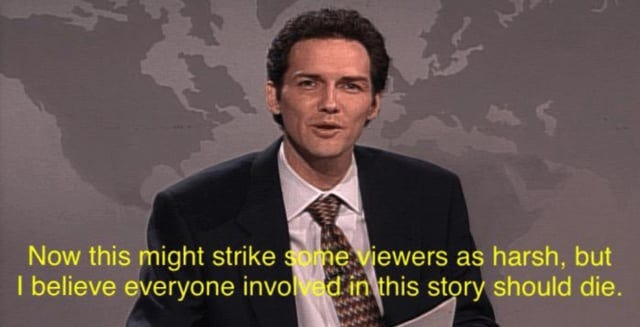
Meta cares a lot about monitoring: racism will not stand, Covid misinformation is not tolerated, and - crime of crimes - antisemitism is purged without mercy. Child abuse? Well, you know, it’s complicated:
A BBC investigation revealed Meta ran paid Instagram ads in India promoting child sexual abuse material using entirely predictable keywords
The automated moderation systems repeatedly dismissed user reports.
To add insult to injury, Meta has systematically fired the human safety personnel
https://www.bbc.com/news/articles/cvgm4e0316zo
US government started making threatening noises about banning Chinese models, because they are cheaper and better they are distilling Claude and therefore stealing from American companies. To the surprise of nobody paying attention, it turns out that two can play that game: Beijing is moving to cut off global access to China's most powerful AI models. In plain English, that means DeepSeek, Qwen, Kimi, and whatnot could become closed behind a hard border. If they go through with it, we will go from “Chinese AI spreading too fast” to not spreading at all.
As a europoor, I am expecting a strongly worded tweet from the EU any day now: how dare the evil Yanks and zii Chinamen restrict European access to AI?
It’s the EU job!
We all know Sam Altman is ethically challenged flexible, but this is seriously next level bad, even for him:
Apple accused OpenAI (alongside its hardware subsidiary io Products) of orchestrating an institutional scheme to “misappropriate” confidential hardware designs
Charge sheet discusses (unreleased) technology specifications, as well as proprietary manufacturing techniques - to accelerate OpenAI’s entrance into consumer AI hardware.
The lawsuit targets high-level former Apple engineers now leading OpenAI’s hardware team, with juicy allegations: they downloaded secret files onto personal devices and encouraged job candidates to bring physical Apple parts and confidential materials to OpenAI interviews.
https://www.documentcloud.org/documents/28453229-apple-v-openai/
Suno has been breached and the results are on the interesting side:
Reportedly exposed evidence that its AI models were trained on large-scale music scraping AND compromising sensitive user payment information.
Internal code reportedly shows Suno harvesting tracks from YouTube Music, Deezer, and even isolated acapella vocals from YouTube
The leaked evidence could strengthen major record labels’ claims that Suno copied copyrighted music directly (as opposed to fair-use web scraping).
Poor Meta cannot catch a break:
The company is being sued by 26 former employees who allege (AI-driven) layoff rankings disproportionately targeted workers with disabilities and those on protected medical leave
Meta says humans - and certainly not AI, no sir, perish the thought - made the final decisions.
The lawsuit comes after Meta cut 8k jobs as part of a broader workforce reduction - trust, safety, and content moderation teams among those significantly reduced. Money talks, bs walks.
Separately, Eightfold AI (the creators of the terminator solution) faces a class action alleging it secretly builds AI-based applicant profiles from personal data to score candidates without their knowledge or ability to challenge the result.
I mean, come on: this is Meta - what were people expecting? Just because Zuckerberg learned to act somewhat human in public, Meta cleaned up its act? If you actually believe that, DM me: I have a bridge to sell.
https://www.theguardian.com/technology/2026/jul/14/meta-ai-mass-layoffs-lawsuit
CUTTING EDGE
Kimi K3 just landed:
Top spot in frontend coding: ahead of Claude Fable 5 and GPT-5.6 Sol, with GLM-5.2 also placing in the top five. First time an open weights model has beaten closed flagships.
K3 has 2.8T parameters, a 1M-token context window, native multimodality, and open weights
Kimi Delta Attention enables up to 6x faster decoding on million-token contexts, while Attention Residuals improve training efficiency by 25pct
The catch? Compute and token efficiency: K3 can outperform leading models on some coding and agentic benchmarks while using fewer output tokens overall, but individual tasks can still consume huge token volumes
API: https://platform.kimi.ai/
Blog: https://www.kimi.com/blog/kimi-k3
FRINGE
First they came for clicks: a German startup MicroAGI offers free apartment cleaning in New York, but every cleaner wears cameras that capture household tasks - to train AI-powered robots, because why else? Following views, now physical-world activity is being turned into training data. Zii Germans are paying more than 10k people across 15 countries USD 20 / h (above NY minimum wage) to record everyday work, then anonymizing (yeah right) and selling the footage to AI labs.
Free cleaning as customer acquisition strategy. Welcome to the new normal.
https://www.bbc.com/news/articles/cpwerjy20kyo
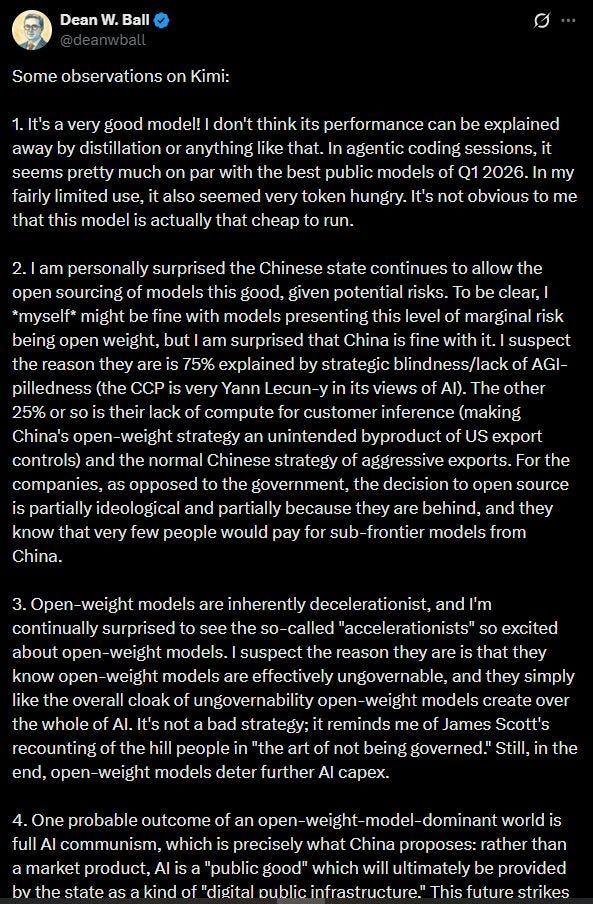
Open source is communism - at least according to OpenAI Head of Strategic Futures (I honestly have no idea what that title means, but sounds important). In lieu of a witty comment, I invite you to read the tweet because that’s one of the most amazing collections of one WTF after another.
RESEARCH
Now that’s a nice one: this review paper connects modern AI forecasting models (including obviously transformers and diffusion models) to vintage classics like Vector Autoregression. It examines how deep learning addresses high dimensionality, nonstationarity, and nonlinearity - while emphasizing the need for econometric inferential tools.
Paper: https://arxiv.org/abs/2607.14279
Everybody knows we need experts in the loop, but how to deal with the fact that they can score forecasts but not generate them (which is polite way of saying they will tell you your forecast sucks - and annoyingly, will be right - but not how to make a better one)? DEFT-ly, that’s how: this new framework that refines forecasts from a frozen time-series foundation model. It balances leveraging the existing predictions with component-wise exploration across trend and seasonal elements. The kiler feature? It improves the quality without retraining the model.
Paper: https://arxiv.org/abs/2607.19659
Time series foundation models are EVERYWHERE it seems - but how to make sense of this growing collections? This new paper surveys and organizes methods for adapting TSFM to downstream tasks using proposing a five-category taxonomy: parameter adaptation, context augmentation, model composition, output processing, and compression. The authors evaluate current methodologies within each category and highlight critical research directions for downstream deployment.
Paper: https://arxiv.org/abs/2607.20002
Oh look: the LLM crowd rediscovered ensembling :-)
Single-model reasoning monitors can be persuaded by an agent’s own reasoning, increasing harmful approvals by 10pct
Using different model families for monitoring and fact-checking reduced policy violations by up to 45pct
Cross-model oversight is a more robust and cost-effective safety approach than relying on one model to monitor another’s reasoning.
Paper: https://arxiv.org/abs/2607.08066
Fine-tuned LLMs can quickly memorize new facts, but theyoften fail to use them in “reasoning” part - because the knowledge is stored in the “wrong” parts of the model. The study shows that factual recall and reasoning rely on different internal layers, leading to an effect the authors call a “Knowing-Using Gap”. They show that by moving the internal representation of facts into the reasoning layers after training, reasoning performance can be recovered to a large degree. This suggests that the main issue is knowledge placement and not model capacity per se.
Paper: https://arxiv.org/abs/2607.08393